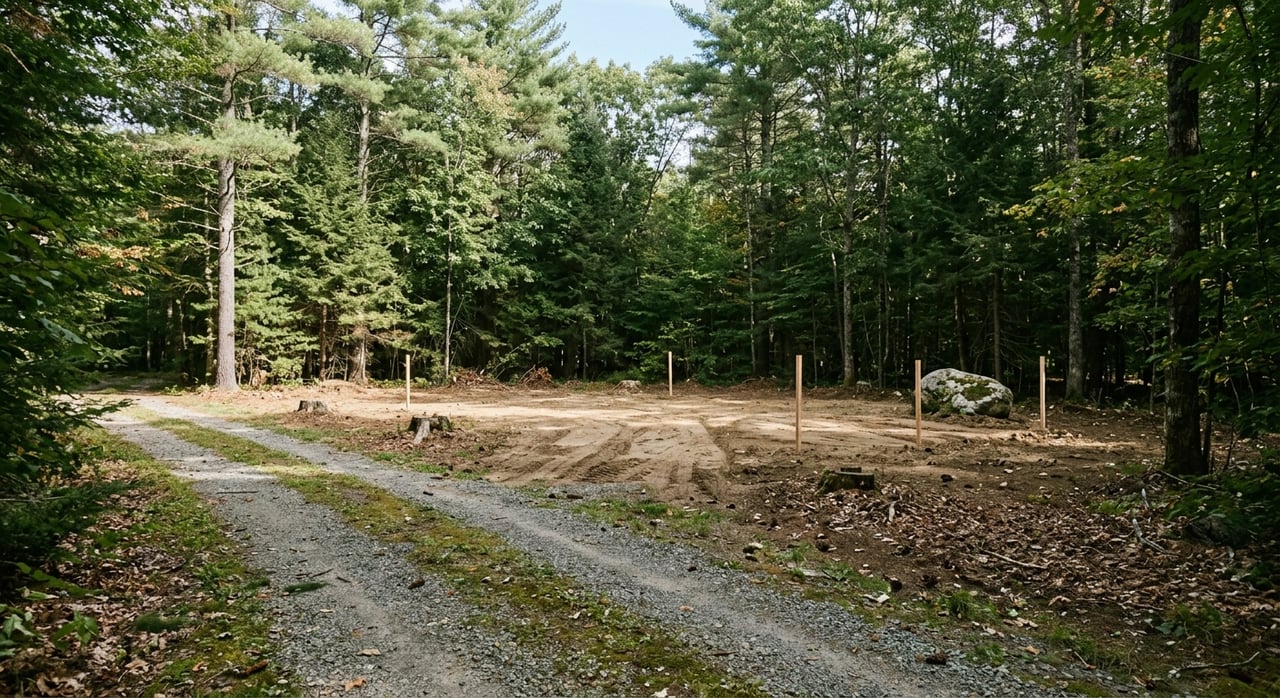
Buying vacant land in Alpena County can feel exciting right up until the questions start piling up. Is the parcel really buildable, who controls zoning, and what does “access” actually mean on a land listing? If you want to move from browsing to making a smart offer, it helps to know how local land listings work and which checks matter most before you commit. Let’s dive in.
Read the listing like land, not a house
Vacant land listings in Alpena County often require a different mindset than residential listings. For land, the parcel ID, legal description, map details, access type, acreage, and frontage can tell you more than the street address.
That matters because local MLS rules for vacant property require legal information, and undeveloped parcels must include a map. For some vacant parcels, the street number may even appear as 0 or X, which is one reason you should not rely on the address alone.
Focus on parcel details first
When you review a listing, start with the legal description and parcel information. Water Wonderland MLS requires legal information for vacant properties and calls for quarter-section details for vacant land, so those fields are important clues rather than filler.
You will also want to compare the parcel by how it actually functions. In practice, many buyers find it helpful to think in terms of road-frontage acreage, access-only parcels, waterfront parcels, or irregular tracts.
Watch for frontage and access terms
If a parcel is waterfront, the listing should identify the access type clearly. Local MLS policy separates frontage from access and distinguishes deeded access, shared private access, and public waterfront access.
That distinction can affect how you use the land and how you value it. A parcel with direct frontage is not the same as a parcel that reaches the water through shared or public access, even if both mention the same lake or water body.
Expect unusual lot dimensions
Land does not always fit a neat rectangle. Local MLS policy allows irregular lot sizes to be entered in dimension formats like x by x or in acreage-style expressions, so unusual sizing is common.
That is not automatically a red flag. It does mean you may need to look more closely at the map, survey history, and legal description before deciding whether the parcel fits your plans.
Know who controls zoning
One of the biggest land-buying mistakes is assuming zoning is handled at the county level. In Alpena County, zoning is local, and buyers should verify zoning with the exact city or township where the parcel is located.
Alpena County’s local government structure includes the City of Alpena and multiple townships. The county’s hazard mitigation plan states that Alpena County does not administer zoning, and that the City of Alpena and all townships except Wellington Township had their own zoning authority at that time.
Verify the exact municipality
Before you make an offer, confirm whether the land sits in the City of Alpena or in a specific township such as Alpena, Green, Long Rapids, Maple Ridge, Ossineke, Sanborn, Wellington, or Wilson. That step matters because zoning rules, review processes, and maps can vary by municipality.
If you are looking at land in Alpena Township, for example, the building department provides zoning resources, zoning maps, site-plan review information, and floodplain map references. That local workflow is a good example of why land buyers need parcel-specific, municipality-specific answers.
Check utilities before you fall in love
A beautiful parcel is not always a simple building site. In Alpena County, utility availability is uneven, so it is smart to confirm water and wastewater service early.
County hazard-mitigation materials state that public water and wastewater are available in the City of Alpena, portions of Alpena Township, and along M-32 through Wilson Township to the county airport. Outside those areas, much of the county is served by individual wells and septic systems.
Public service is not countywide
If the parcel is outside the areas served by public systems, you will likely need to evaluate private well and septic feasibility. The same county materials note that Thunder Bay is the source for all public water in Alpena County, but that does not mean every parcel can connect to public service.
This is one of the most important practical differences between buying a house and buying raw land. With land, you often need to prove the site can support the systems you plan to use.
Use a vacant-land evaluation
District Health Department No. 4 offers vacant-land evaluations to determine whether a building site is suitable for an onsite sewage disposal system. This can be especially useful if you are buying now and planning to build later.
DHD4 also notes that an approval letter is not a permit to construct a system. Results can change if site conditions or rules change, which is why timing and current documentation matter.
Understand what reviewers look for
The DHD4 site-plan form shows how detailed land review can be. Reviewers look at lot dimensions, tax ID, building and driveway locations, easements, the water well, septic area, replacement septic area, surface water, soil-boring locations, and utilities.
That list gives you a helpful preview of what to think through before making an offer. It also reminds you that a parcel can seem workable at first glance but still raise site-planning questions once the details are mapped out.
Look closely at wetlands, floodplains, and shoreline issues
Some of Alpena County’s most appealing land includes water, low areas, or natural features that may require extra review. If you are considering waterfront, shoreline, wetland, or low-lying land, permit questions may come up before any building starts.
EGLE permit categories cover wetlands, inland lakes and streams, Great Lakes, and floodplains. EGLE defines floodplain as land inundated by the 100-year flood and requires a permit before altering the 100-year floodplain of a river, stream, or drain.
Ask early, not later
This does not mean every parcel near water is a problem. It does mean you should ask early whether planned work could trigger review for wetlands, shoreline work, inland lakes and streams, or floodplain alterations.
That is especially important if your plans include clearing, grading, adding a driveway, or changing the site near water. Early answers can help you avoid expensive surprises after your offer is accepted.
Do not skip soil erosion rules
Land buyers sometimes focus on the building itself and forget the site work needed to get there. In Alpena County, clearing, grading, and driveway work may trigger soil erosion requirements.
The county’s soil erosion ordinance regulates earth-change activities. It also states that fees are doubled if work begins without a permit, so checking this before starting work is a practical way to protect your budget.
Review split history and buildability claims
If a seller says a parcel is buildable because it was recently divided, slow down and verify the history. Michigan’s Land Division Act governs divisions of unplatted land for sale or building development when the split creates parcels under 40 acres or equivalent.
This matters in real-world land purchases because split history can affect how a parcel is treated. DHD4’s site-plan form also asks whether lots under 1 acre were split or recorded after July 1997, which is a useful reminder that division history can connect to septic review and buildability questions.
Ask for the paper trail
A thoughtful land buyer will want to confirm whether the current parcel configuration was legally created and whether any prior split affects future plans. If you hope to build, resell, or divide again later, this step is worth the extra time.
It is also one more reason to look beyond the marketing remarks and focus on the parcel record. For land, the history often matters just as much as the view.
Build a smart offer around due diligence
A strong vacant-land offer in Alpena County usually leaves room to verify the things that matter most. In practical terms, that often means confirming access, title, zoning, septic and well feasibility, wetlands or floodplain constraints, and survey or split history before you are fully locked in.
That approach is not about making an offer weak. It is about making your decision informed, especially when raw land can have more unknowns than an existing home.
A practical pre-offer checklist
Before you write an offer, make sure you have reviewed these basics:
- Confirm the parcel ID, legal description, and access type.
- Confirm the zoning with the correct city or township and ask whether site-plan review is required.
- Confirm whether the parcel needs a vacant-land evaluation, septic and well approval, or another health department review.
- Confirm whether wetlands, inland lakes, streams, shoreline issues, or floodplain limits may affect your plans.
- Confirm whether grading, clearing, or driveway work may require a county soil erosion permit.
- Confirm whether the parcel’s division history raises any Land Division Act or buildability questions.
Use the right local offices
One of the best ways to buy land with confidence is to work from the local record outward. Alpena County and local municipalities each handle different parts of the process, so knowing where to go can save time.
The Alpena County Equalization Office is useful for GIS, assessment, taxable values, and property-record search resources. The Register of Deeds records deeds, mortgages, land contracts, liens, and similar documents, and notes that original documents are required for recording.
Your local information sources
As you move from search to offer, these are the offices buyers commonly use:
- Alpena County Equalization Office for GIS, assessment, taxable values, and property-record search resources.
- Alpena County Register of Deeds for land-record recording and recorded document searches.
- City or township building departments for zoning, site-plan review, floodplain maps, and building permit guidance.
- District Health Department No. 4 for vacant-land evaluations, septic permitting, and well-related review.
- Alpena County soil erosion enforcement for earth-change and sediment-control permits.
- EGLE for wetlands, inland lakes and streams, floodplain, and shoreline-related permit questions.
Why local guidance matters on land deals
Vacant land can offer a lot of freedom, but it also asks more of you upfront. In Alpena County, success usually comes from matching the listing details with the real-world facts on zoning, access, utilities, site conditions, and permit pathways.
That is where local, appraisal-informed guidance can make a real difference. If you are comparing acreage, waterfront access, or a future build site, it helps to have someone who understands how these parcels are valued and what questions to ask before you write.
If you are thinking about buying vacant land in Alpena County and want practical help from search to offer, reach out to Aimee Smith.
FAQs
What should you verify first when buying vacant land in Alpena County?
- Start with the parcel ID, legal description, access type, and the exact city or township where the land is located.
How do zoning rules work for vacant land in Alpena County?
- Zoning is handled locally, so you should verify rules with the specific city or township rather than assuming Alpena County controls zoning.
Why is a vacant-land evaluation important for Alpena County property?
- District Health Department No. 4 uses vacant-land evaluations to help determine whether a site is suitable for an onsite sewage disposal system.
What utility issues should buyers check for Alpena County land?
- You should confirm whether public water and wastewater are available or whether the parcel will rely on a private well and septic system.
When do wetlands or floodplain rules matter for Alpena County land?
- They matter when the parcel includes wetlands, shoreline, inland lakes or streams, or land that may be within the 100-year floodplain.
Can clearing or driveway work require permits on vacant land in Alpena County?
- Yes, earth-change activities such as clearing, grading, or driveway work may require a county soil erosion permit.